
In 1275 the Age of Consent was set, for the first time (because up until then there had been no such thing as Age of Consent) at 12 years of age.
And there it remained for 600 years, until it was raised to 13.
Since then it’s been up and down and all over the place.
In recent memory it used to be 21.
It’s currently 16.
All of these changes were instigated by politicians, and were put in place without any scientific basis to their decisions.
Up until 1964 there was no maximum speed limit on the UKs motorways, until the Daily Mail led a campaign to establish a maximum speed limit.
The following year the speed limit was established, and it was set at 70mph and, apart from during the oil crisis of 1973, when the maximum speed was reduced to 50mph for oil consumption reasons, the national speed limit has remained at 70mph.
Since 1965 all road vehicles have become safer.
Braking systems have become more efficient to a level that the drivers (and vehicle engineers) of 1965 would not have been able to comprehend.
Road surfaces have become better.
And yet the Government’s official braking distances have remained unchanged.
It was Clarkson (late of Top Gear) who clearly demonstrated the official braking distances to be actually based on inaccurate data, when he safely braked a 2.5-ton Bentley from 60mph to 0 in less than half of the 240′ that the Highway Code said it would take.
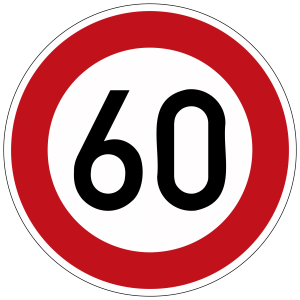
Yet still the national speed limit remains set at 70mph.
Oh, I know that the Conservative Transport Minister Philip Hammond announced, in September 2011, that the national limit would rise to 80mph, but he was, to use a technical phrase, talking political bollocks.
His precise words were:
“Now it is time to put Britain back in the fast lane of global economies and look again at the motorway speed limit which is nearly 50 years old, and out of date thanks to huge advances in safety and motoring technology.
“Increasing the motorway speed limit to 80mph would generate economic benefits of hundreds of millions of pounds through shorter journey times. So we will consult later this year on raising the limit to get Britain moving.”
But after that speech he went on to do what politicians usually do.
He did nothing.
So here we are, over 50 years after the introduction of the 70mph national speed limit, and not a serious, scientifically-based review of it in sight.
Which is odd, really, because right now local authorities around the country are lowering the speed limit.

And they are doing so with the same lack of scientific evidence to support them.
Large stretches of A-roads are having their speed limits sneakily, and arbitrarily, cut by local authorities, and having them cut without any public consultation.
Many roads are having limits lowered, despite the public now having better-designed cars, with more efficient braking systems, and much improved road surfaces.
It’s bonkers really.
It’s nanny stateism.
Just look at the huge number of A-roads that have quietly had their speed limits reduced from 60mph to 50mph, or even to 40mph and in some cases to 30mph.

All because someone, in the service of the public, and without any scientific evidence (the key word there is evidence), just feels like screwing over a few thousand motorists a week.
Or just because they have had what they consider to be ‘a good idea’.
I mean, you may as well ask a bunch of geriatric MPs to legislate on the Age of Consent (and then ignore their own decision, because they are, after all, MPs and we all know that the law doesn’t apply to MPs).
Or maybe I’ve had an overdose of cynicism today?
Our speed limits here vary from state to state. In Texas we also have “school zone” limits where there are white signs with a set of times on them indicating when the speed limit drops from 45 to 20. They also have flashing amber lights to remind you in case you failed to read the (quite small) text as you zoom past. During the school zone times you’re extremely likely to encounter a partially-hidden police vehicle or vehicles armed with laser or radar speed detectors. The lasers are there for the smart asses who have radar detectors in their vehicles to alert them off imminent police attention.
We also have red light cameras, with a $75 fine if you run the light.
Our ‘motorway’ equivalent speed limit is 75mph. We also have a yearly vehicle inspection which checks for less than the British MOT but specifically looks for excessive emissions and to check the operation of standard safety features like tread depth, brakes and other such basic components.
We have no static speed cameras that I know of. In my experience the mobile police-operated ones are more effective anyway since you can’t zoom and decelerate like you would between British static cameras.
In Nebraska the speed limit was mostly 60, but, due to a legal challenge years back they have no red light cameras, in fact no static speed cameras of any type. They also have no vehicle testing at all – it’s ‘The Man’ spying on ‘The People’ and The Constitution liketh not this imbalance of who precisely works for who.
The age of consent in Nebraska and Texas is 17. However both states have a rule that says a lower age of consent is permissible if the age difference between the parties is two years or less. Worth noting that the voting and drinking age is 21.
So anyway, if I speed-read through your post correctly (see what I did there?) – I get the gist that you’re suggesting the age of consent in the UK should raised to 40. Am I right?
Having been in Asda in Leicester yesterday, I think the age of consent should be lifted to somewhere around 75 years of age.
The age of consent is up and down like a whore’s drawers.
The problem with the maximum speed limit is that many take no notice of it anyway. I travel on the motorways daily, and – once we get out of the car-park sections – I travel along at just under the limit but have a steady stream of cars flying past me doing at least 80 or more. If we increase the limit, these same people will probably still not be satisfied and will take it up 90.
And the faster you go, the quicker your reaction time has to be. Yes, cars are better at stopping in shorter distances nowadays, but we aren’t all Formula 1 drivers… for sure.
My journey home this week has been disrupted twice, both times by accidents and both times by prangs in the ‘fast’ lane, where the drivers haven’t been able to stop quick enough.
Me, I’m all for keeping the maximum limit as it is. We can all just leave ten minutes earlier.
Yours
Miss Daisy
Dear Daisy,
The local A-road (A606) used to be 60mph. And then the little local councils began chipping away at the speed limit. It’s now mostly 40mph, with one or two short runs of 50mph. The rest is 30mph. Instead of 60mph. And all done without referring to central government, and without scientific evidence.
Sort it out, will you? There’s a good Daisy.
Here, en France, our motorways have two limits, 130kph (about81) when dry and 110kph (68mph) when wet. And by and large everyone sticks to it give 1 to 2 kph. If I set the cruise control for 129kph I can sit there quite comfortably overtaking a few slower vehicles and lorries and occasionally being overtaken. They are pretty good at signposting the speed limits and you soon know what the limit ought to be just by road type and how built up a place is. For m, 80mph is about right for the motoray. For years now I have found cars “settle at about 80 and it doesn’t require yu to either accelerate or decrease speed a lot.
One of the problems with the decreasing speed limits is indeed the nanny state and the fact that the motorist is now the evil of society. The message these days is that motorists will kill less children if they drive slow, rather than less children will die if they stop running into the road in front of cars becaue as we know, children can never be to blame for anything these days. But that’s a different rant.
“The message these days is that motorists will kill less children if they drive slow, rather than less children will die if they stop running into the road in front of cars because as we know, children can never be to blame for anything these days”
Wise, wise words.