I’m studying for my Yachtmaster exams. This involves a lot of reading because, believe it or not, there’s a big bucketload of very serious information that you need to have in your head before you sit down and take the exams. Later, having passed your exams, you go out on a boat and put it all into practice (usually for a week) under the stern gaze of an examiner. The syllabus covers all the things I did for my Skipper exam last year, but in much more depth and detail. Much. More. Detail. I’m currently reading up on tides which, keeping a boat on the North Wales coast, is particularly important because the Irish Sea is very tide-y (I’m confident that’s a word). If it was just high water and, at the opposite end of the period, low water, that would be ridiculously easy. But there’s complications. Big complications. These are the highest astronomical tide (HAT) and lowest astronomical tide (LAT) which need to be planned into (or planned around) every seagoing passage. The tidal height difference between HATs and LATs is massive.
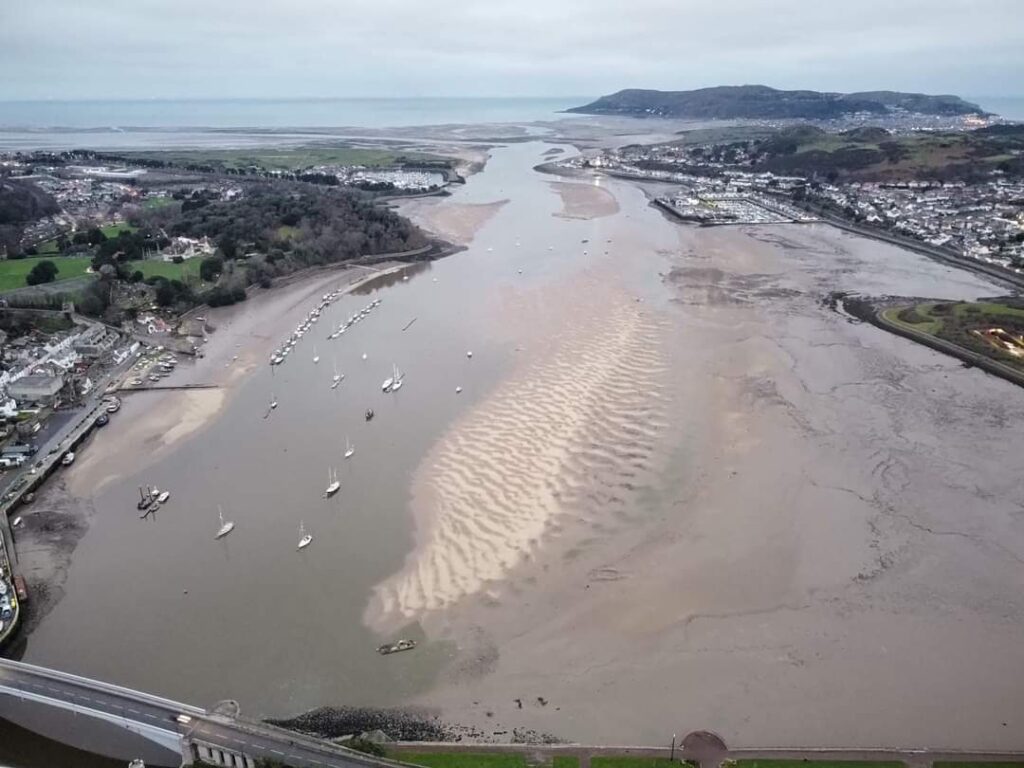
Recently, during the LAT at Conwy, a chap sent up a drone to photograph the river. The photographs not only showed the difference between a normal low tide and the LAT, they also clearly show the shifting sandbanks in the river. That’s the thing with the flipping shifting sandbanks, they move around. The Conwy gets dredged (as do the two marinas), but the river is so large that only the main shipping channel (nothing to do with radio) gets regularly dredged; keeping the Conwy fully dredged would be like painting the Forth Bridge.
There are two routes to sail down the Conwy and out into the bay. The more correct passage is to take the main shipping channel out to the Fairway Buoy, then make for whichever direction your course is plotted. If, however, one knows the passage, as an alternative to the main shipping channel there is the North Channel which is a quicker, more straightforward route out into the bay past Great Orme’s Head. You need a degree of familiarity with the North Channel, especially if your boat has a deep draft. Nobody wants to be stuck on a sandbank!
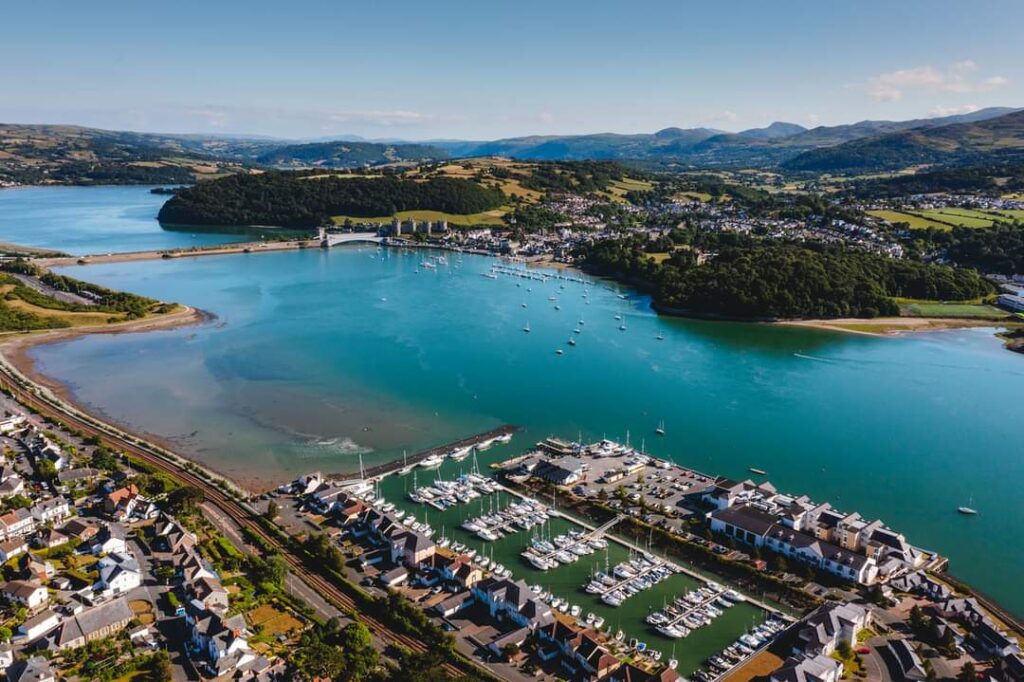
So here’s just two photos to compare and contrast. The first photo, below, is the River Conwy at high tide, showing Deganwy Marina in the foreground. In the background you can see the road bridge leading to Conwy Castle and the town beyond. But look at the river.
The second photo, below, was taken above the Conwy roadbridge, so it’s just a reverse view of the first photo except this one was taken at LAT. You can see the main shipping channel, cutting away to the left after the mouth of the river. The North Channel is visible, but it would be impassable, even by dinghy! You can also see a number of the shifting sandbanks. I’ve checked my charts, and none of those sandbanks are where they should be!
And it’s stuff like this is why the Yachtmaster exam is so flippin’ difficult.
That’s a lot of hard work, just for “messing about on the water”, as the Hoseasons advert used to say.
I wish you luck, skipper.
The Yachtmaster exams are tough, but you should see the syllabus for the Yachtmaster Ocean exams!