I have to create a sound-bed (a piece of backing music) for a scripted narration.
The narration hasn’t been recorded yet, but reading through the script I can see it will probably come in at about 2m 5s.
In order to wrap the listening experience up, I need the sound-bed to begin a few seconds before the narration starts. There should be enough of a musical intro to engage the listeners. Then it should fade to allow the narration to impose itself, but the sound-bed should continue almost muted below the speech.
As the narration concludes the sound-bed should swell upwards and continue the listener’s engagement for a few seconds before ending.
The mood that the sound-bed has to set is confident but not intrusive or pushy; uplifting and, as I’ve said, engaging.
The most obvious choice for the perfect sound-bed is HoppÃpolla by the Icelandic musical wizards, Sigur Rós.
But, as a musical expert said to me earlier, HoppÃpolla has been a tad overdone in recent years. It’s almost impossible to watch BBC1 these days without hearing it.
I really want to use just one piece of music; using one piece for the lead-in and a different piece for the fade-up/lead-out will, I strongly believe, lack audio consistency – no matter how well edited.
But there is a striking piece of music by James Dean Bradfield that, musically speaking, has the same intro and the same outtro (26s and 24s respectfully).
Unfortunately there is a lot of singing after the 26s and before the 24s, but I have the germ of a cunning plan…
What if I allow the James Dean Bradfield intro to start and then take the fade at about 22s but, as the scripted narration starts, I take the fade down to such a low level that although it would still register as musical/audio background, it would be low/quiet enough to allow me to edit/mix it in to a piece of similar style/pace/rhythm for as long as I need (approximately 1m 15s)?
And then I could do another cunning edit/mix when required to bring in/fade up the last 10-15s of the James Dean Bradfield outtro?
Well that’s the theory anyway.
I want to use the James Dean Bradfield intro/outtro for a number of reasons:
- It’s a stunning work of art
- It’s aurally captivating
- It ticks all of the requirements (see above)
- It has *exactly* the same start and end (and that’s v.unusual)
So I’ve started work on the cunning plan. As you can see from the screenshot below I’ve created three tracks.
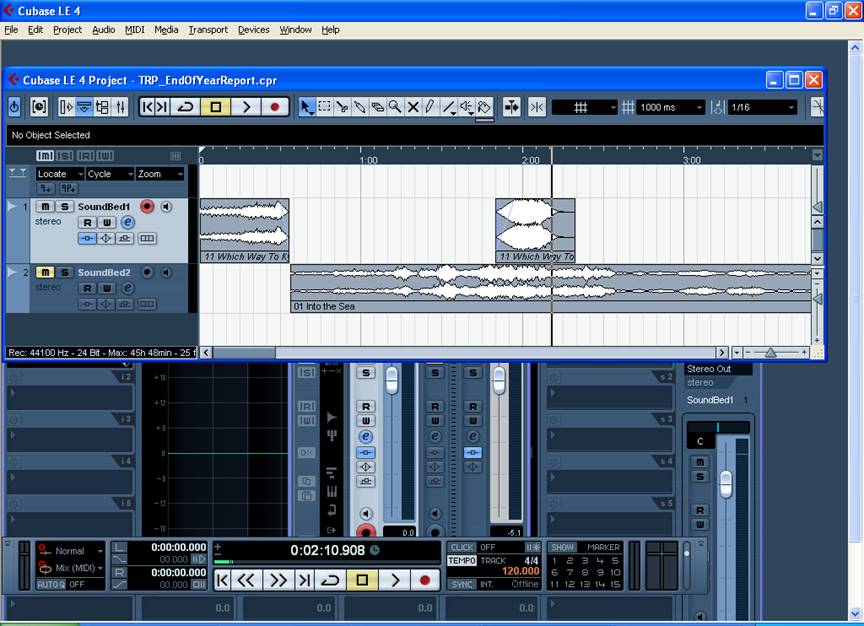
The first track is called SoundBed1 (how imaginative. Not) with the intro, then a loooong gap and then the outtro.
The second track is called SoundBed2 (I’m consistent if not imaginative) with the proposed ‘middle bit’.
What I need now is track 3 – the narration.
When I have that I can position it to the required place over the intro in track 1. Then I can manipulate the outtro in track 1 to where that needs to be. And then I can master the musical/sound-bed levels down so that they support the narrative. Oh yeah, and trim the excess/unwanted from track 2.
So that’s what I’ve done this evening.
What about you?
p.s. I think it’s time for an episode or two of 24.
An Open Letter to My Dear Husband (currently mirroring me across the table in headphones and staring at a laptop),
I too could do with an episode of 24. And some chocolate. Just to break up this Very Important Work I have been doing this evening. However, just let me finish listening to ‘All For Believing’, please?
Mwah xxx
As you have the bed ducked well below your narration, couldn’t you filter out the frequencies containing the vocal and then use the resulting output?
I’ve heard that done quite effectively before…
Soph: I’m ready for a 24 when you are!
Daniel: Yes, yes, yes, yes, yes, yes. No. Well, what I mean is yes, that’s possible. But not with my amateur set-up. If I had access to a professional studio I think that’s very do-able. But sadly, not here, not now.
Hmm… worth a stab – there’s a plethora of tools out there that can do it (some freeware as well).
The only other thing I would suggest (and this is a bit like teaching grandma egg-sucking), is editing your 2min-ish of audio up first (preferably a smidge long – easier to lose time in a read than gain it) and then working to that length as opposed to making the bed fit the words – thus removing the need for a clunky edit in the middle to make it all line up.
(Nothing against your editing skills, but odd cuts in musical tracks are often appreciable to the listener, even if they don’t know the song in question).
So it’s done. The end of year report for This Reality Podcast: http://thisrealitypodcast.com/audio/EndOfYearReport2009.mp3