The first grown-up bike (now there’s an interesting philosophical discussion point) I had was a 1,000cc Laverda Jota.
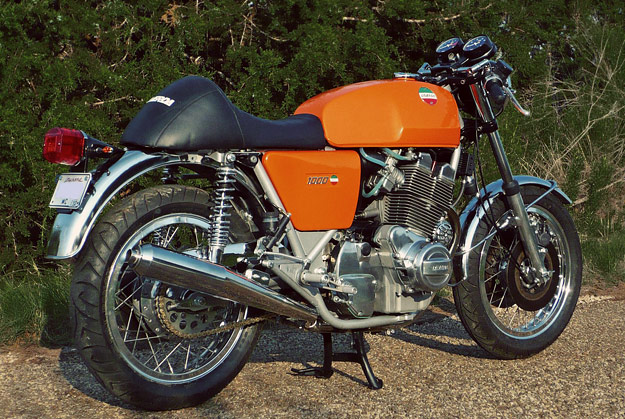
I bought it in Germany, almost as soon as my little feet touched down at the RAF nuclear strike station I was posted to.
The Jota was the ultimate 70s superbike.
On the plus side of the balance sheet, the Jota had frighteningly quick acceleration, and handled brilliantly – as if you were welded to it.
On the negative side, the Jota had two issues.
It was quick to discharge its battery if you rode with the headlight on. And even in those unenlightened times, it was compulsory, in Germany, to ride with the headlight on at all times.
The other unfortunate point about the Laverda Jota was that although it had superbike performance, it had slightly less braking power than a fully laden supertanker.

I got scared a few times on that bike.
There’s nothing like cruising down the autobahn at approaching 140mph, and then finding that one has no chance of pulling up within slightly more than a half mile.
I’d like to say that the Jota came in to its own on the Nürburgring, but really, the absence of resilient braking on a track famed for its fearsome ‘steep gradient drop in to hard corner’ combinations, means you won’t ever be able to push the Jota anywhere, except along a straight where you can decelerate using the gearbox.
But since those hairy scary days, motoring technology has changed, and brakes now match engine performances.
In recent years I’ve had three motorbikes.
The Suzuki Bandit GSF650 (a sports/tourer), the Honda VFR800 (also a sports/tourer), and the Triumph Daytona 955i (a superbike/sportsbike).
The first thing to say is that the Suzuki Bandit got me back on two wheels after years of absence, and brought back all the fun memories, the moment I sat on it.

I used the Bandit as a runaround in the local area for weeks, with occasional longhops, and a few significantly longer journeys.
The Bandit’s 650cc engine is surprisingly grunty.
It has a declared top speed of 130mph, but I only got it up to 120mph once.
The immediate difference between the Bandit and my first big bike – the Jota – is the brakes.
The Bandit will allow a touch of rear brake to steady up, sure, but if you really need to stop you just apply the front brake and… instant stop!
Also, you get none of that nasty rear-end lifting that the Jota (and the Yamaha FZ750 I had years after the Jota) was all to quick to show off.
I realise these things are due to an overall improvement in motorcycle braking systems across all makes, but it’s the first difference I noticed between my last few bikes (many years ago), and the Bandit.
Working up through the gearbox, the Bandit’s 4cyl engine makes a delicious noise, but the engine is at its best in the midrange.
Oh, and the fuel economy on the Bandit is stunning; if you have one and don’t ride it like a mentalist, it will give you tremendous value per gallon.
But, interestingly, with a full tank of fuel the Bandit is decidedly top heavy – the most top heavy bike I’ve ever sat on (which isn’t that many by some people’s standards).
There’s just something about the weight distribution of the Suzuki Bandit that, on a full tank, makes the centre of gravity so high up the frame that it is, at very low speeds, unstable.
I almost soft-dropped her outside the house, one day, performing a simple slow-speed U-turn. And when one takes the full weight of the bike on one leg, one notices that she’s heavy.
But she’s very comfortable, and easy to ride for hours on end.
But as the Bandit and I spent time together, and as we undertook more long-distance, high-speed trips, I began to notice a thing; she seemed to be working just a little bit too hard.
The engine was just a bit too noisy and strident.
Selling the Bandit was actually very difficult, but I knew it was the right thing to do.
I had been looking at Honda VFRs on the internet for a few weeks, but I bought the first one I looked at.

She was beautifully clean; the product of a proud and loving owner.
She had an immaculate but unofficial (owner-maintained) service record, and she looked and felt positive.
That was my initial thought about the VFR: that she felt positive.
Steering: positive
Gearbox: positive
Balance: positive
Response: positive
Brakes: positive
She was just too good-looking, too positive, and too… well, tidy, to pass up.
One thing I noticed very quickly on my way home with my new prize; the Honda VFR800 felt lighter than the smaller Suzuki Bandit GSF650.
Well that shouldn’t be, should it?
But she did.
And she balanced much better than the Bandit. Even on a full tank, the VFR did not feel top heavy.
Actually, the 800cc VFR weighs in at 208Kg, whilst the 650cc Bandit weighs in at 201Kg, so the difference is just 7Kgs in the Bandit’s favour.
And they both have metal fuel tanks.
But the reason the VFR feels lighter than the Bandit is the distribution of weight.
The VFR has a much lower centre of gravity, so a greater proportion of its weight, compared to the Bandit, is below the 75% height line.
Both bikes are firmly in the sports/tourer class.
Both bikes offer a non-aggressive rider position (though the VFR inclines the rider slightly more forward than the Bandit).
Both bikes have excellent braking systems (front and rear), and both bikes have better-than-average mirrors as standard.
But the VFR has, undoubtedly, a bigger engine.
It’s not so much that she’s so much quicker 0-30, 0-60, 0-100, than the Bandit, it’s the effortless way the VFR performs through all of those ranges.
I also feel that the VFR is much more balanced than the Bandit at all speeds – including very slow manoeuvring.
And the Bandit, as much as I loved her, did get very noisy when she was working hard; the VFR stays sweet and sounds as if she’s not really exerting herself.
As far as fuel goes, the VFR is thirstier than the thrifty and frugal Bandit, but the bigger engine is such a joy to listen to that really… I just don’t mind the expense.
In some ways, the VFR feels like she is a bigger step-sibling to the Bandit.
These are both factory-standard bikes, not heavily customised machines.
Even riding them, they felt remarkably similar.
But the VFR is just more…
Positive.
As fond of the Bandit as I am, the VFR is a more well-rounded machine. It’s not just the extra lump of cc. The VFR is a better mannered and more capable bike.
She’s just a bit more grown up, compared to the Bandit.
And then there’s the Daytona.
I had always intended to keep the VFR as my commuter; that’s the kind of daily hard work that the 800cc sports/tourer can effortlessly cope with.
But I had been looking for something… zippier… for fun and weekend smiles.
I don’t know why I started focussing on the Triumph Daytona 955i.
I tested a Triumph Street Triple 675cc about 18 months ago; I was unimpressed.
But every time I looked for a sportsbike/superbike, I kept coming back to the Daytona.
Who wants a Gixxer?
They’re everywhere.
I wanted something fast, stylish, distinctive, and sporty.
And the triple-cylindered Daytona 955i ticks those boxes.
Why didn’t the triple-cylindered Triumph Street Triple tick those boxes? Because it just looked meh. And it was only a 675cc engine. And I didn’t feel as if we were part of each other.
Eventually I found a very tidy Daytona for sale near here.
Three weeks later I went to see it. And try it out.

I sat on it in the showroom.
And I nearly dropped it.
What I means is, the first time I sat on the Daytona *I* nearly lost *my* balance.
The engine wasn’t running. I cocked my leg over the saddle, and lowered my bum on to the seat.
I pushed the bike up off its stand with my left leg and Oh My God I’m Going To Overbalance And Fall Over.
Except I didn’t – I saved it.
But how did that happen?
It’s down to weight again.
Or, in the case of the Triumph Daytona 955i, it’s down to the lack of weight.
The Daytona 955i weighs in at 191Kg.
This is lighter than both the 650cc Bandit and the 800cc VFR and what the hell is that all about?
Plastic and carbon fibre, my friend, plastic and carbon fibre.
And, although she’s lighter, the Daytona also manages to cram almost all of her weight below the 75% line.
It’s as if you are sitting on a 250cc – seriously, it is. I’ve spent a lot of time on a GPZ500, and that felt much heavier than the Daytona.
As you would expect from a a superbike/sportsbike, the Daytona puts the rider in a very aggressive forward position.
I think this is why the Daytona caught my eye, and I also think this is why all of the current crop of naked bikes passed me by. The Daytona oozes style and…
The sportsbike/superbike ergonomics, coupled with the bike’s stunning design, make the Daytona in to something out of the ordinary.
It’s as if she’s preparing you for what’s waiting to be unleashed from that large lump of three-cylindered wonderfulness, sitting just below the plastic fuel tank.
This is very subjective. There are Gixxer owners out there who would say their bike has a unique look and feel. And Blade owners. But I didn’t want to be the owner of another four-cylinder Japanese superbike.
I wanted something different.
And how different can a British-built, triple cylinder, sportsbike/superbike be?
Turning the Daytona over on the key is wonderful.
The starter turns slowly and for a millisecond one thinks ‘Oh God, she’s not going to start’. But she picks up quickly and fires on all three cylinders.
The engine sounds larger than the near-1000cc powerplant.
The sound the Daytona makes is stunning.
There is something about this triple-cylinder engine that produces the most awesome noise.
As you sit on this (comparatively) weightless machine, and listen to the engine idling away, you wonder what, precisely, it is capable of.
Hmm…
At very low speed the Daytona isn’t a great fan of being worked in first gear.
In fact, pulling away, one needs to put significantly more fuel in to the engine than any other bike I’ve ridden; you really have to give it some revs.
Once you’re rolling, though, you open the throttle and get a whole new appreciation of just how quickly this bike can accelerate.
And it’s when one is making progress that this bike comes in to its own.
Pulling the rider onwards, tempting you, seducing you with a comely flick of the throttle and a twitch of your hips, and suddenly she’s off, and you’re grinning wider than the Cheddar Gorge is long, and you’re in to third and doing 60mph, and you want to put it in to fourth, and then fifth, and then sixth, and oh my God this bike is beautiful.
The balance of the Daytona is, I have to say, exceptional.
I tried a Gixxer 1K recently and although I loved the ride, I didn’t feel that the bike was part of me. I felt as though I was sitting on a thing.
With the Daytona, the throttle/engine is so responsive, and the balance is so beautifully articulated, that the bike feels as if she belongs between my thighs.
Fore and aft braking is exceptional (but the stock mirrors could be improved).
No matter how hard the bike is being worked, no matter how quickly it is travelling, touching a little front or a little rear brake to steady things up never feels unsafe.
I haven’t done a track day with the Daytona yet (weather!), but I have had just one opportunity to open it up.
We topped out at an effortless – oh, so effortless – 141mph.
I know the Daytona has a top speed of somewhere around 160mph, but I’m never going to get there. Not even on a track day.
However I do know how effortless it was for the bike to achieve 141mph, and that’s enough for me.
Despite the larger engine, I find the Daytona to be more economical than the VFR.
But I’m going to keep the VFR as my daily workhorse/commuter; it can eat up the start/stop/slow-speed grind.
The Daytona and I will have much weekend fun together.
And the Daytona is so very comfortable that I’m planning a longer trip.
Around Andalusia.
This Spring.
Oh, insurance?
The Bandit cost me £122/pa fully comp. The VFR costs me £125/pa fully comp. The Daytona costs me £138/pa fully comp.
I love the Daytona.
It is nimble, it is light, it is super speedy, it is hyper-responsive and – unlike my first superbike – it has tremendously awesome brakes!
But she does scare me, a little, every time I get on.
Because I push her off the stand and…
There’s no weight there!
It’s good to be scared, right?
Yes, it is good to be scared – helps keep you alive.
I won’t comment as I’d have too much to say – be much easier over a cup of tea sometime.
It’s enough to say: thanks, I really enjoyed reading that.
When the weather breaks (ha!), we should meet up at the Super Sausage or similar, and have a gossip.